Useful Information
All information from https://www.southafrica.net/ unless otherwise credited.
Electricity
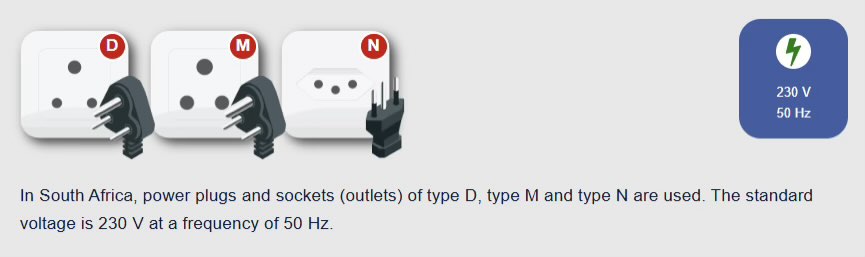
The South African electricity supply is 220/230 volts AC 50 HZ. With a few exceptions electricity is available almost everywhere. Don't forget to bring a power converter for your electronics.
The most common plug is type M. If you are coming from Australia, the UK, or Europe, your dual-voltage devices (like phones and laptops) will work fine, but you will need a physical travel adapter. If you are coming from the US or countries using 110V–120V, you will also need a step-down voltage converter. Most South African wall sockets feature a small on-off switch next to the plug holes. Make sure the switch is flipped to "on" if your device is not charging.
Image and information from https://www.power-plugs-sockets.com/
Population
South Africa is home to multi-cultural melting pot of 55 million beautiful people of diverse origins, cultures, languages, and religions.
Languages
Although English is widely spoken and is used for informational signage, South Africa celebrates diversity in language with a total of eleven official languages. These languages are Afrikaans, isiNdebele, isiXhosa, isiZulu, Sepedi, Sesotho, Setswana, Siswati, Tshivenda, Xitsonga and English.
Religions
Enshrined in the South African constitution is the right for all people to practice their religion free from persecution. The most practiced religions in South Africa include Christianity, Hinduism, Islam, Judaism and Buddhism.
Currency
The Rand (ZAR) is the official whole currency unit in South Africa. A Rand is the equivalent of 100 cents. Currency denominations include 5 cent, 10 cent, 20 cent and 50 cent coins, as well as 1, 2 and 5 Rand coins. 1 Rand is the equivalent of 100 cents. Bank notes include denominations of R10, R20, R50, R100 and R200.
Tips and tipping
In South Africa your tip should be at least 10-15% of your bill. In some restaurants, you will notice that the tip is included in the total.
Payments
Most major international Credit Cards are accepted throughout South Africa, including Visa and Mastercard. Although widely accepted American Express and Diners Club sometimes may not be accepted. ATM's are widespread and most will allow visitors to withdraw Rands directly from bank or credit cards.
Forex
Forex desks are situated at most airports to exchange currency. In addition to this most major retail banks are able to assist with currency exchange. These forex desks will produce a quote for the exchange which must be agreed to in order to exchange currency.
Health
South Africa has a well-developed healthcare system. There are both public and private hospitals throughout South Africa. Be sure to top up on medical insurance before leaving home. Well-qualified doctors, dentists and specialists can be found easily, but it is advisable to make an appointment unless it is an emergency.
Malaria
While most of South Africa is malaria-free, this mosquito-borne disease is prevalent throughout the year in the Kruger National Park and the low-lying areas of northern KwaZulu-Natal. Consult a healthcare professional about a suitable prophylactic. Your choice of drug will depend on how long you are visiting the malarial area, the time of year and your personal health.
Yellow Fever
South Africa requires all travellers journeying from or transiting through yellow fever risk countries to show proof of yellow fever vaccination by means of a valid yellow fever certificate.
Climate
South Africa is known for its long sunny days throughout the year. Most of the country experiences rain in summer, however the Western Cape has predominantly winter rainfall. Average day temperatures in summer (December to February) range from a minimum of 15°C (59°F) to a maximum of 28°C (82°F). In winter (June to August), average day temperatures are 19°C to 23°C (66°F to 73°F).
Airports
South Africa’s three major international airports are O.R. Tambo International Airport (Johannesburg); Cape Town International Airport; and King Shaka International Airport (Durban).
Road or rail
Speed limits are set at 120km/h on highways; 100km/h on secondary roads; and 60km/h in urban areas. Alternatively, you can travel by train around the country.
Disability
Major hotel chains have ensured facilities for travellers with special needs. If you require additional assistance, it is always advised that you verify with the accommodation and experiences you are interested in to ensure that your needs are met. If you require additional dispensation or assistance when hiring a vehicle, most of the major vehicle rental companies are able to assist.
Communication
South Africa has a well-developed communications infrastructure. A number of network providers offer national coverage and there are well-established landline phone networks. Internet and Wi-Fi is easily accessible in most urban areas at hotels, restaurants, shopping centres and public places.
Electricity
The South African electricity supply is 220/230 volts AC 50 HZ. With a few exceptions electricity is available almost everywhere. Don't forget to bring a power converter for your electronics.
The most common plug is type M. If you are coming from Australia, the UK, or Europe, your dual-voltage devices (like phones and laptops) will work fine, but you will need a physical travel adapter. If you are coming from the US or countries using 110V–120V, you will also need a step-down voltage converter. Most South African wall sockets feature a small on-off switch next to the plug holes. Make sure the switch is flipped to "on" if your device is not charging.
Image and information from https://www.power-plugs-sockets.com/